Targeting Green Subsidies
Overview
- Last class we compared taxes and subsidies for reducing emissions.
- Punchline: subsidies can never achieve the efficient outcome.
- But they are politically easier to implement than taxes, so they are widely used. That motivates studying how to design subsidies optimaly.
Subsidies involve more policy design than taxes
- Pigouvian taxes involve relatively little policy design. Simply tax emissions at their marginal social cost.
- Subsidies are more complicated. We need to decide:
- What to subsidize (EVs, solar panels, wind turbines, etc)
- How much to subsidize (fixed amount, % of price, etc)
- Who gets the subsidy (all buyers, low-income buyers, etc)
Application: Electric Vehicles
Share of EVS
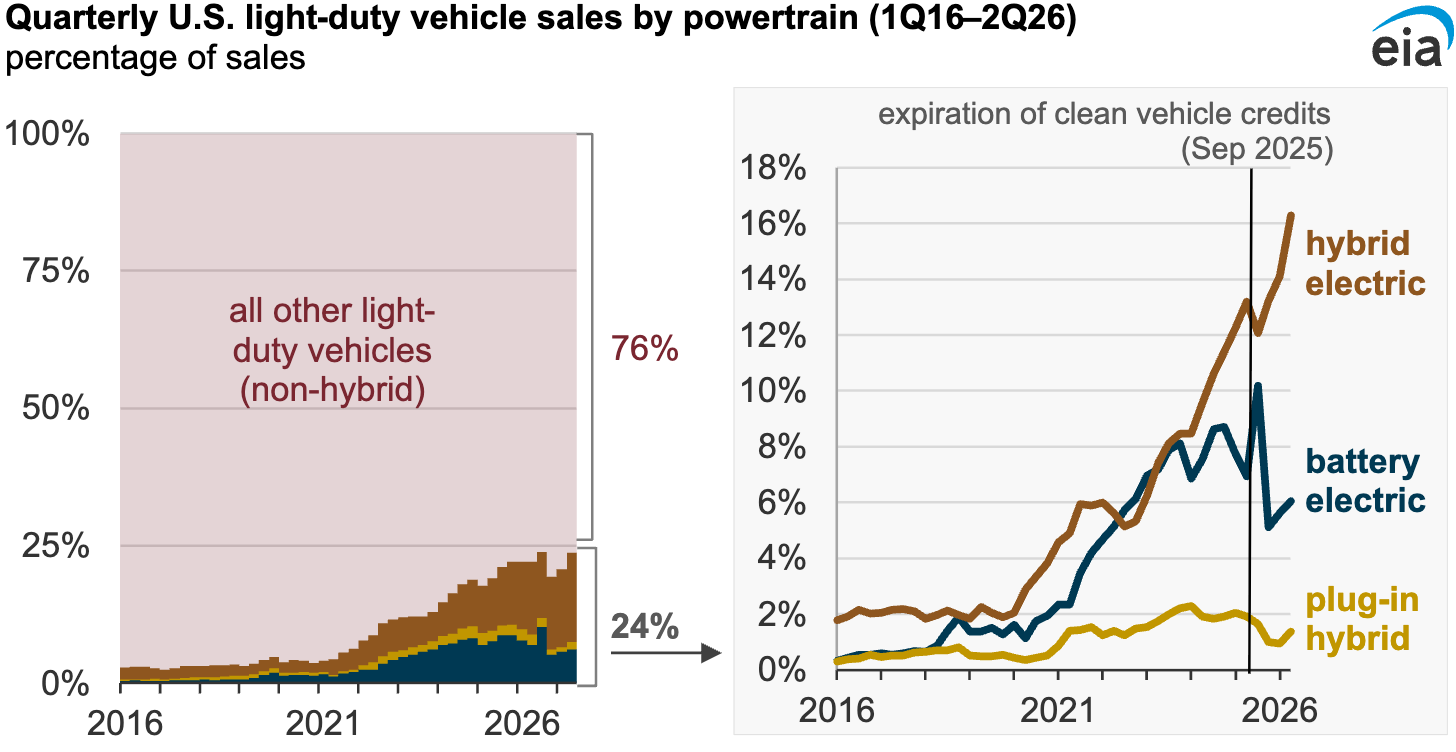
Note: US lags behind other markets
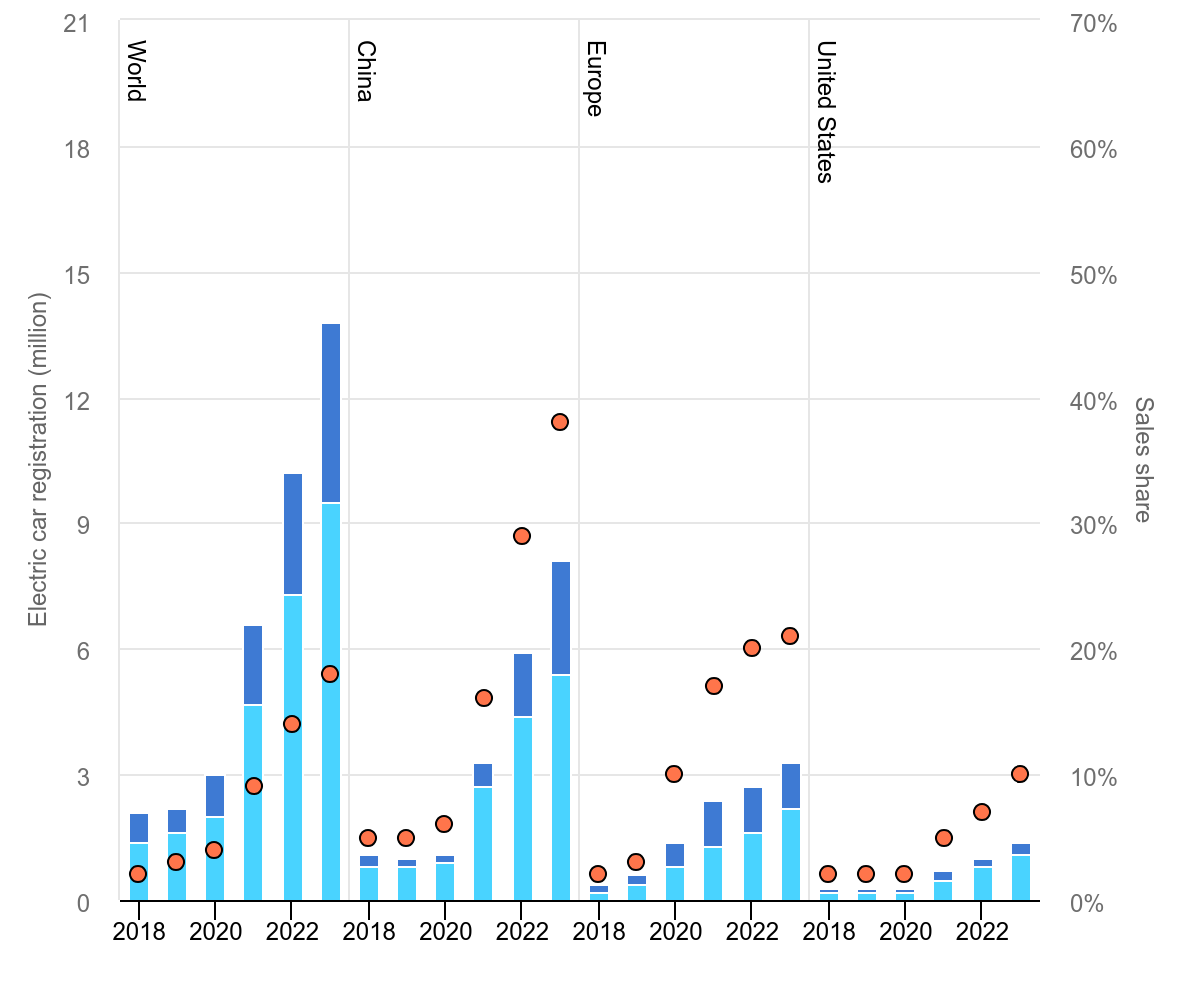
EVs are a central pillar of the energy transition
- Reminder: Plan is to electrify everything.
- And then decarbonize electricity.
Question: How should we subsidize EVs?
- Who should get the subsidy? How much?
- What criteria would you used to decide?
Subsidy targeting
Modest Goal: Cost-Effectiveness
Idea: Get the most EVs per dollar of subsidy (or hit some EV target at the lowest cost)
- Government budgets are constrained
- Want maximum environmental benefit per dollar
- Poorly designed subsidies waste money
Metric:
\[\text{Cost per additional EV} = \frac{\text{Total subsidy spending}}{\text{Additional EVs induced}}\]
What Determines Subsidy Cost?
Key parameter: Demand elasticity
\[\varepsilon = \frac{\% \Delta \text{ in quantity}}{\% \Delta \text{ in price}}\]
Demand elasticity determines:
- How many additional EVs the subsidy induces
- How many people get subsidies who would have bought anyway
Marginal vs. Inframarginal Costs
Every subsidy hits two types of consumers:
Marginal effect (what we want):
- Induces NEW purchases
- People buy BECAUSE of the subsidy
- These are “additional” EVs
- Creates social benefit
Inframarginal effect (waste):
- Subsidizes EXISTING demand
- People who would have bought anyway
- No change in behavior
- Pure transfer, no social benefit
Problem: We can’t tell who is marginal vs. inframarginal – so everyone who buys an EV gets the subsidy
Visualizing the Problem
Defining Additionality
Additionality = Fraction of subsidized EVs that are marginal to the subsidy
\[\text{Additionality} = \frac{Q_s - Q_0}{Q_s} \approx \frac{\varepsilon \cdot s/P}{1 + \varepsilon \cdot s/P}\]
- Demand elasticity (ε)
- Size of subsidy (s)
- Base price (P)
Higher |ε| → higher additionality → more cost-effective
Example: Which market segments to target?
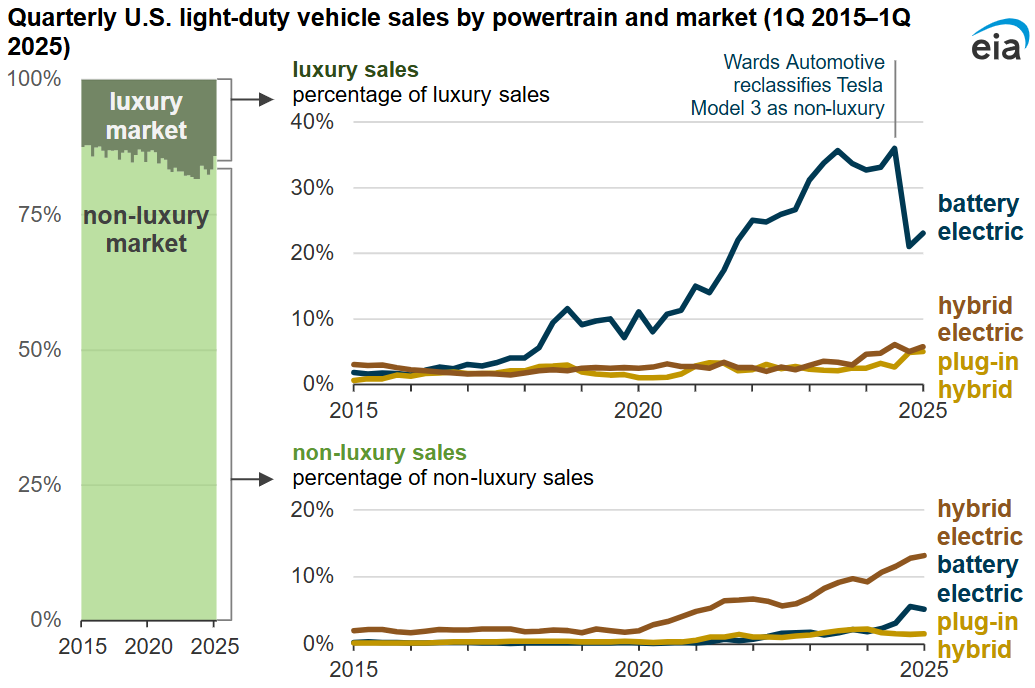
Case 1: Tesla Purchases in California
Assumptions:
- Average Tesla price: ~$80,000
- Combined subsidy: $10,000 (12.5% of price)
- % increase in quantity demanded = (|elasticity|) * (subsidy/price)
- cost per car = (subsidy * Qs)/ (Qs - Q0)
| Elasticity | Additionality | Cost per Additional EV ($000) |
|---|---|---|
| -1.5 (low) | 16% | $63.3 |
| -2.5 (mid) | 24% | $42 |
| -3.5 (high) | 30% | $32.9 |
Even with a high elasticity, 70% of Tesla subsidies are wasted on inframarginal buyers, and the cost per additional EV is $33k!
Case 2: Non-Tesla EVs in California
Assumptions:
- Average non-Tesla EV price: ~$35,000
- Combined subsidy: $10,000 (29% of price)
| Elasticity | Additionality | Cost per Additional EV ($000) |
|---|---|---|
| -1.5 (low) | 30% | $33.3 |
| -2.5 (mid) | 42% | $24 |
| -3.5 (high) | 50% | $20 |
Lower-priced vehicles have better cost-effectiveness, but total cost per additional EV close to the price of a car itself!
Policy Implication: Who to Target?
To maximize cost-effectiveness, target:
1. Lower-priced vehicles
- Higher subsidy as % of price
- More elastic demand
2. More price-sensitive consumers
- Lower-income households
- More responsive to subsidies
To date EV subsidies have not been equiable
Average EV Credit per Tax Return, By Income Level
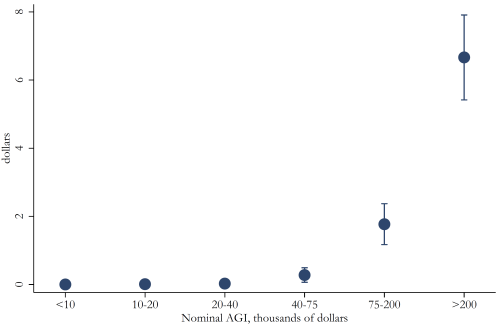
Source: Davis
Targeting emissions reductions
We don’t actually care about the number of EVs, but about emissions reductions they provide.
- CO2 taxes penalize exactly the margin of the relevant externality.
- If a car pollutes more, it’s cost to drive goes up more.
- People buy less / use them less, and emissions go down.
- Green subsidies work through substitution: CO2 emitting goods become relatively more expensive, so people buy less / use less.
- This only works well if the green goods subsidized are really close substitutes for polluting goods.
Subsidy Targeting Summary
- The social optimum amount of EV’s is surely higher than current levels.
- Petroleum externalities are largers than electricity externalities (in most places)
- We need to decarbonize transportation to meet climate goals.
- The optimal policy would be to put Pigouvian taxes on gasoline.
- This would hit on both the extensive margins (what cars people buy) and intensive margina (how much they drive).
- Instead policymakers have opted to subsidize the EV transition.
- This will be expensive, but some subsidies are more cost-effective than others.
- Targeting lower-priced vehicles and more price-sensitive consumers improves cost-effectiveness.
- Targetting subsidies geographically to areas with cleaner grids and higher pollution damages would also better target the environmental benefits.
Econ 3391 - Subsidy Targeting